Through Concentration and Focus to More Success
By Michael Wutzke, , updated

Develop Your Strengths!
On June 24, 2020, the second Management Lab of Policen Direkt Versicherungsvermittlung GmbH took place. The Management Lab training series takes place for interested employees on a voluntary basis every 6 weeks after the end of work. Prerequisites for participation include a willingness to work on topics and projects beyond regular working hours and to complete the program for around 18 months. Various Policen Direkt executives and external coaches will speak during the mentoring program.
After the kick-off event on February 12, 2020 about the Gallup system, the focus this time was on the focus on work. HR manager Samira Arrami from Policen Direkt guided the employees through an online session lasting around two hours. This type of event was necessary because the number of on-site meetings was limited due to the corona crisis.
Flooded by the Media
The modern employee is currently exposed to a variety of distractions. Here a phone call, there an email and then the smartphone again.
According to Business Insider, the average user touches his phone 2,517 times, in one day! Due to the constant fire on activities many reach an intellectual performance limit. This is not only a strain on the brain, it also reduces the likelihood of success at work in the long run. So what can you do about it?

The Essentials Count
At the beginning, Samira Arrami briefly introduced the 4C method of learning (communication, collaboration, creativity and critical thinking). This model is intended to combine self-directed learning and the acquisition of knowledge. However, Cal Newport’s methodology was the main focus. He is a lecturer at Georgetown University in the United States and the author of numerous publications. Cal Newport is an expert on work in the 21st century and postulates the so-called deep work methodology.
The use of deep work, according to Cal Newport, is one of the most valuable skills that employees have today for their own work in business. Deep work is a concentrated work, the aim of which is to create assets that are as productive as possible, to work on innovative topics and thereby produce impressive results. Because the state of fully concentrated and focused work is becoming increasingly rare today. The majority of us are constantly fighting
- with the ever changing technology,
- parallel communication channels,
- being online permanently and
- the need to “be involved all the time”.
Constant tasks that do not require full concentration often fill up the time and prevent us from tapping into the depth of our potential.
Levels of Deep Work
In everyday work, we are supposed to master complex tasks in a very short time and deliver results at an elite level in terms of quality and speed. So how can we develop concentrated work as a basic professional skill? And what are the risks if we don’t?
Samira Arrami presented the individual variants of how you can use deep work for your work. During the use of a deep work phase, you do without social contacts, emails, social media, phone calls, discussions with colleagues, smartphones and other factors that you do not urgently need to complete a certain task.
Deep work is best used for certain projects. You choose one of the following philosophies in a project:
Monastic Philosophy You can achieve top performance by withdrawing like a monk. We should try to hide the outside world as much as possible to avoid possible distractions.
Bimodal Philosophy By using the bimodal phase, you can concentrate on the project for at least one day, up to a maximum of a few weeks.
Rhythmic Philosophy If it is not possible to isolate yourself for days, you set blocks of time in which you can work on a task undeflected. It is important that these intensive work phases return regularly and are not interrupted by anything.
Journalistic Philosophy Journalists are used to delivering top performance at the push of a button. In this sense, you can simulate a deadline at the beginning of the day and set very specific goals that must be completed at the end of the working day.
Relaxation and Reward Perhaps the most important step on the way to concentrated work: take breaks. Regardless of whether the deep work unit took a few hours or even days, the brain deserves a break afterwards. There are different ways to relax, such as a bath, meditation, sport, an evening with good friends or a lonely walk through your own neighborhood. The main thing is that we switch off properly, because the brain works like a muscle: if you tense, you also have to relax to fully regenerate.
The modern world of work will no longer slow down. However, we are not helpless about this process. Methods such as deep work and mindfulness training are ideal additions to everyday work, because they can help us to work more concentrated, switch off if necessary and really enjoy the end of the day at the end of the day.
Concentrated work is an acquired skill, like playing the guitar, it doesn’t work without constant practice.
*, Cal Newport *
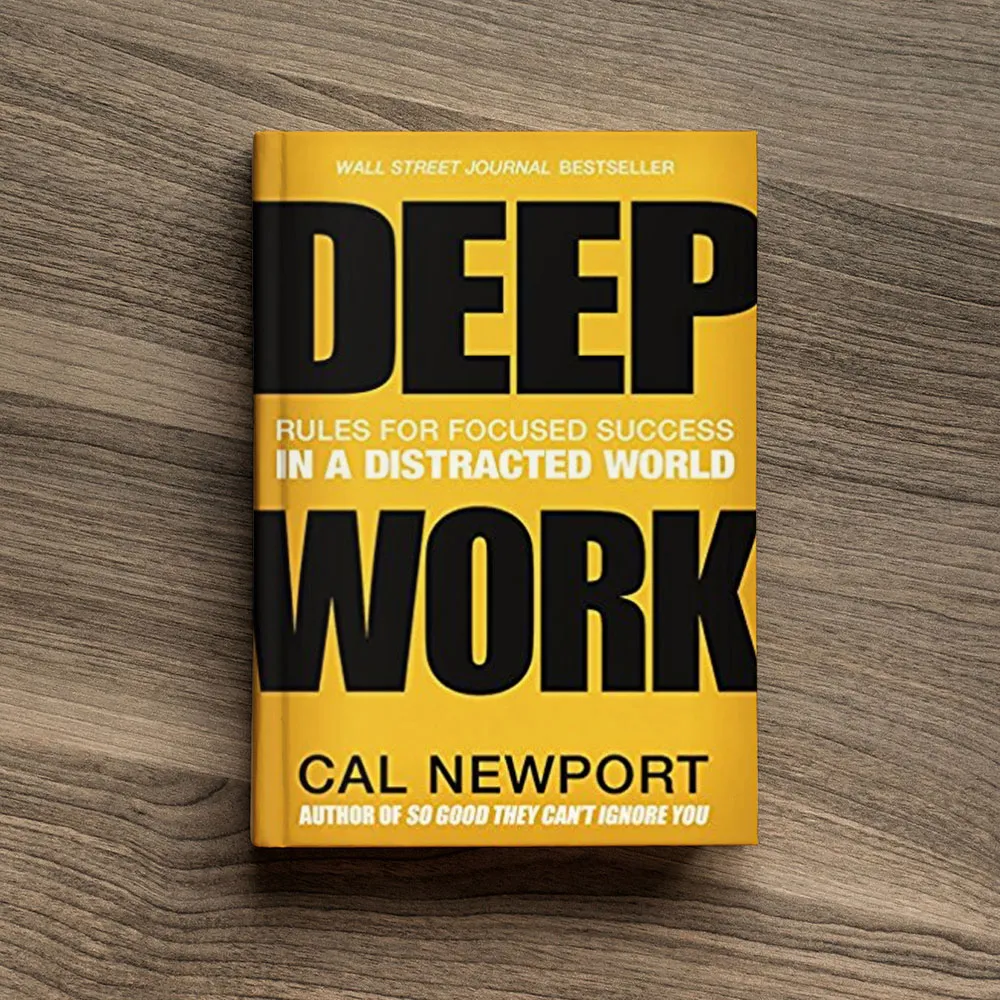
The philosophies of Deep Work (Amazon) are explained in detail in the book by Cal Newport.