Digital transformation consulting for the Mittelstand in Germany
I help Mittelstand firms move work that runs on paper, by email and in spreadsheets into web applications that staff and customers use. We start with one process, and I build the software for it myself. Let's talk about your needs in a free 30-minute video call.
What I take care of for you
-
Digitalization experience
For more than twenty years I have designed web systems and questioned concepts that made work harder. I start with the people who type the data today, your staff and your customers.
-
Customer portals
I built an insurance manager in which thousands of customers upload and manage their policies, connected to the CRM the company already used (customer count from 2016 to 2021).
-
Documents behind a login
I built a portal through which a financial services group shares its Money Laundering Act documents with companies, each behind a personal login. Your files reach the right people without an email attachment.
-
Data protection from the start
A process with personal data gets its GDPR measures before the first line of code. I have documented such measures, put them in place and written the technical parts of the legal documents.
-
IT leadership
As CIO of a Frankfurt fintech I held the IT budget and coordinated development, infrastructure, product and sales. A new application works when the people who use it helped shape it.
-
Based in Frankfurt
I live in Frankfurt, work remote for firms across Germany and travel for workshop days on site. I work in German and English.
Where digital work stops in a Mittelstand firm
It stops between the systems. An order arrives by email, someone types it into a spreadsheet, and a colleague copies it into the ERP. A customer sends a scanned form, and it waits in a shared mailbox until somebody has time. Each copy costs time and adds typos, and nobody sees the status of a case without asking around.
The firms themselves give their digitalization a middling mark. In the DIHK’s digitalization survey of nearly 5,000 companies, published on January 28, 2026, they rated it at an average of 2.8 on the German school scale, where 1 is the best mark (DIHK, January 2026).
What I build for it
I replace the copy steps with one web application that holds the data once. Customers or staff enter it in a form, the application checks it, and the systems behind it receive it through an interface. The application shows the status of each case to the people who need it, and roles decide who may see and change what.
In my projects, digitalization has a start and an end: one process moves into one application on a switch date. The next process follows once the first one runs.
Which process to digitize first
Score each candidate process from 0 to 2 on the six questions below before our call. The process with the highest sum is the first project. Personal data raises the score because spreadsheets and mail folders make it hard to protect under the GDPR.
| Question | 0 points | 1 point | 2 points |
|---|---|---|---|
| How often does the process run? | Monthly or less | Weekly | Daily |
| How many people touch one case? | One | Two | Three or more |
| Where is the same data typed twice? | Nowhere | In one step | In several steps |
| Do customers or suppliers wait on it? | No | Sometimes | For each case |
| How do you learn the status of a case? | From one system | By asking one person | By asking around |
| Which personal data does it hold? | None | Staff data | Customer data |
A process that scores high on the first four rows and low on the last one makes a good first project: it saves work soon and carries little legal risk while your team gets used to the application.
Cases from my work
- At Policen Direkt, a company in the German secondary market for life insurance, I built a digital insurance manager with colleagues. Thousands of customers upload and manage their policies in it and order products of external partners (customer count from 2016 to 2021). I programmed the front end in Angular and connected the portal to the existing CRM.
- A portal with personal logins through which a financial services group provides its documents on the Money Laundering Act to companies.
- A system that rates warehouse locations. When the formulas change, it updates the results and shows them as statistics.
- A date-based reminder service that emails hundreds of thousands of customers about holidays and recurring events (customer count from 2011 to 2016).
Who I am
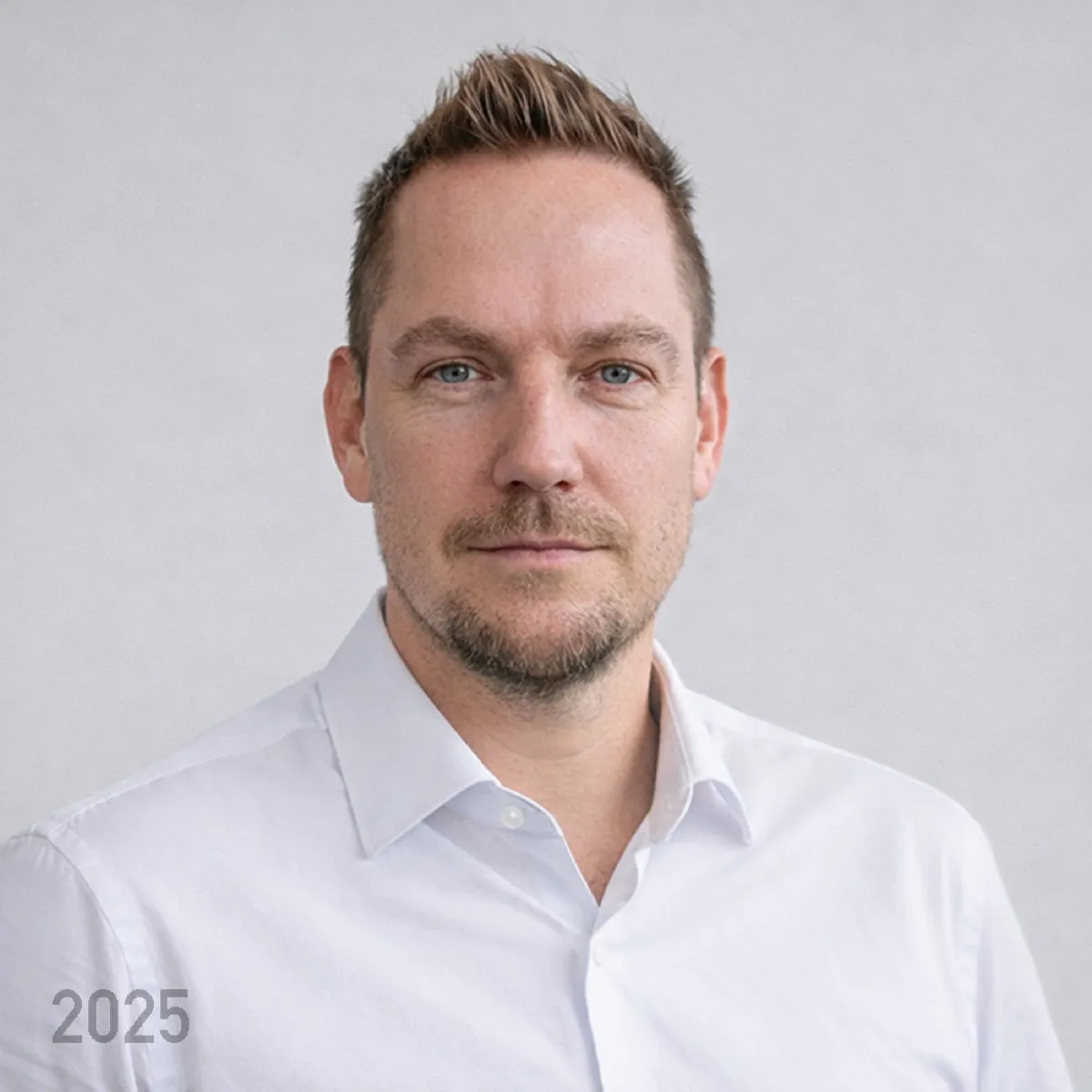
I am Michael Wutzke. I have worked in IT and media for more than twenty years, and at an e-commerce company of Burda Digital I was the IT link between management and marketing. At the Frankfurt-based company Blocksize Capital I was Chief Information Officer, with the IT budget and the disciplinary lead of business-critical teams. Today I use Claude and Codex daily and teach at Claude Hacker House. I am also interested in open-source AI models that a firm runs on its own servers. Details: Background.
How a digitalization project runs
-
Free video call
In 30 minutes you describe the process that costs your team the most time, and I ask where its data comes from and where it goes.
-
Walk through the process
We go through the process together, on site or by video, with the people who do the work, form by form and spreadsheet by spreadsheet.
-
Quote and order
You get a quote for the first process. When you accept it, the work starts.
-
Build at a test address
The new application runs at a test address with real cases from your firm. Your team tries it there while the old way keeps running.
-
Switch
On a date you set, the process moves to the new application. The data from the spreadsheets moves with it, so nobody types it again.
-
Handover
Your team gets a short guide and an admin login. Later changes go through your own AI agent or through me.
Questions companies ask
Which process should we digitize first?
The one that runs often, passes through several hands and makes someone type the same data twice. The scoring table on this page helps you find it before our call. When two processes score the same, the one your customers wait on goes first.
Do we have to replace our ERP or CRM?
Usually not. A first project connects to the systems you have. The customer portal I built at an insurance company fed the CRM it already used, through an interface.
Which technologies do you use?
The process decides. Web applications with logins and a database I build on Symfony or Laravel, or on Node.js, with a front end in Angular or React. They run on your own servers or in the cloud, for example on AWS.
How do you handle personal data?
Before the build we write down who sees which field, how long a record stays and where the servers stand. I document these measures, and the application enforces them through roles and logins.
Does AI play a part?
Where it saves work, yes. An AI agent can sort incoming documents or prepare a draft that a person checks. The process has to be digital first, because an agent cannot read a paper folder.
Do you work on site?
I live in Frankfurt and meet clients on site in Frankfurt Rhine-Main. For firms elsewhere in Germany I travel for the walk-through and the switch; the rest runs remote. I take on digitalization work as freelance projects, in German and English.
Details on the work behind this page
-
A digital insurance manager on AWS
An insurance manager in Angular, life insurance portals and AWS infrastructure in two regions.
-
Realized projects
I am using AI technologies to rapidly create MVP and production-ready applications.
-
Product conception
From the first concept to the roadmap: advice on digital products, based on more than twenty years of product and IT projects.
-
CIO and Head of DeFi at a Frankfurt fintech
Node operations, a market-data product, teams, budgets and procuration at a Frankfurt fintech.
Your digital transformation consultant in Germany
I am Michael Wutzke, a digital transformation consultant in Germany, based in Frankfurt. In a free 30-minute video call we look at the process that costs your team the most time, and you learn what a web application for it would change.
Searches this page answers
- digital transformation consulting
- digital transformation consulting services
- digital transformation consultant
- digitalization consultant
- digital transformation services for small businesses
- digital transformation small business
- digital transformation smes
- digital transformation strategies for small and medium enterprises
- digitalization germany
- digitalization of business processes
- digital transformation of business processes
- business process digitization
- process digitization
- digitizing business processes
- workflow digitization
- digital workflow examples
- digital transformation roadmap
- digital transformation roadmap template
- digital transformation examples
- what is digital business transformation
- digitalization vs digital transformation
- digitalization vs digitization
- spreadsheet to web app
- convert excel spreadsheet to web application
- excel to database
- customer portal development
- customer self service portal
- crm integration
- crm integration services
- paperless office
- paperless office solutions
- it consulting for small businesses