AWS cloud
The cloud operating system
Amazon Web Services (also called AWS Cloud) is a cloud services provider and therefore something like an operating system for Internet-enabled services. The AWS Cloud can be used to provide functions that were previously located in a separate data center or rack: file servers, web servers and database servers. What is special is that these resources are “scripted”, i.e. they can be created, stopped and deleted via interfaces. But AWS can do more than this:
Hundreds of other services have been added in recent years that work in a similar way, can be combined as desired, and have certain advantages over a conventional implementation. The main advantages of the AWS Cloud are that customers have full control over their services, and that the services can be scaled practically without limit on request and rolled out at many locations worldwide.
AWS also meets all data security requirements that companies in Germany are subject to.

More specifically, a cloud services provider consists of these components:
- Infrastructure as a Service (IaaS),
- Platform as a Service (PaaS),
- Software as a Service (SaaS) and
- Function as a Service (FaaS).
Infrastructure as a Service means that customers have access to IT services over the Internet, for example data storage or computing power, and can use them anywhere and on different devices. Platform as a Service describes the use of a cloud platform over the Internet to develop web applications. Software as a Service is browser-based software that an external service provider makes available and that several users can use at the same time (an example of a SaaS service is Google Docs). Function as a Service (FaaS) is a category of cloud computing services that provides a platform allowing customers to develop, run, and manage application functionalities without the complexity of building and maintaining the infrastructure typically associated with developing and launching an app (for example Lambda as part of the AWS Cloud).
In addition to AWS, there are several other providers of cloud services, such as Azure (Microsoft) and the Google Cloud Platform.
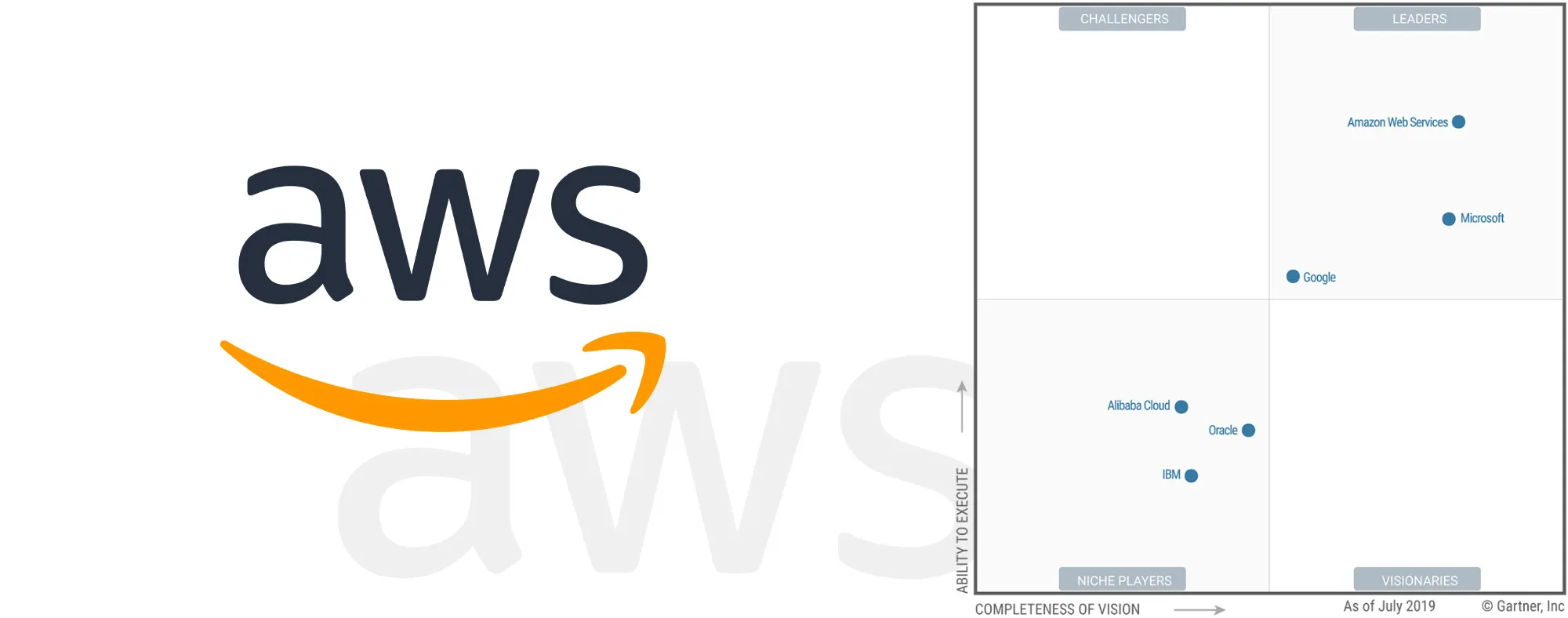
Main AWS services
I worked with the basic AWS services EC2, S3 and Route 53 especially between 2018 and 2021. Before that, I installed, configured and provided hardware myself in the data center for more than 10 years. Cloud services free a DevOps engineer from “manual” work in the data center and shift the work to the software level.
I decided to take AWS certifications because I am very interested in the topic of cloud computing and want to get to know as many aspects of the AWS Cloud as possible. I am now certified as an AWS Solutions Architect Associate.
The most important building blocks in everyday AWS use are:
Virtual servers
AWS offers virtual servers with the EC2 service, for example. Here you can choose between Linux distributions and Microsoft Windows as the operating system. Billing depends on the online time (by the hour or by the second), the memory used or the compute units. Serverless services such as AWS Lambda are an alternative to virtual servers.
Storage space
You can store almost “unlimited” amounts of data on AWS, and you are billed for the storage space you use. Data is stored via the file hosting service S3, which numerous other AWS services use in the background.
Networking
The content from AWS services (e.g. EC2 or S3) can be delivered globally using CloudFront, a content delivery network (CDN). The global distribution reduces access time. Services like Route 53 enable things that conventional domain services do not allow, such as DNS failover: a replacement server takes over if a server fails, for example.
Furthermore, AWS can protect your websites and APIs against DDoS attacks on layers 3, 4 and 7 of the OSI model.
Databases
With Relational Database Service (RDS) you can start a highly available database system within a few minutes, with a choice of all common database products such as MySQL, Microsoft SQL Server or Oracle. Or you can switch to big data systems like Redshift if you want to analyze large amounts of data.
Tools
AWS provides many online tools that enable developers to program, analyze, debug, test and deploy applications. Such tools support the trend toward microservices and away from monolithic applications.
AWS Marketplace
A huge selection of software tailored to the AWS platform can be booked via the AWS Marketplace. Numerous applications from the areas of IoT, AI or Big Data can also be found here.
The cloud sector is still in its infancy and will continue to grow in the coming years as companies move more and more services there. Major innovations are also expected in the fields of big data, artificial intelligence and machine learning.
Did you know…? Amazon Web Services is the market leader for cloud services. But it’s not the only one. In recent months I have also been involved in projects using Azure and GCP (Google Cloud Platform).
Michael Wutzke, AWS Certified Solutions Architect Associate in Frankfurt